Sunday, January 25, 2015

What Had Happened Was . . .

Writing has always been one of my strengths. In middle-school I wrote a story called "Pink and Grey" about Donna Lynn's death that my grandmother kept for many years.  In high-school Mr. Daley, my 9th grade English teacher, told me that a dystopian short story that I wrote was one of the best that he had ever read, professional or otherwise.  The best compliment I ever received was when my father told someone that I was a better writer than he was.  He is not one for compliments or flattery, but when my senior thesis about Father Divine won the Ruth J. Simmons prize in the African-American Studies Program at Princeton, I know he was proud.  He alone rode the train with me to the university to collect my award.
Why I was wearing a tube top to an awards ceremony is beyond me!
Despite my early promise, for some reason, I stopped writing after college.  Perhaps without the extrinsic motivation of deadlines and grades I didn't see the point.  Unfortunately, in my adult life, my talent with words was spent writing book long text messages to men who didn't care enough about me to read them (or respond for that matter).  I would write something and look at my deepest thoughts and feelings glowing back at me from the phone screen and think "damn, that was good!  I should be a writer."
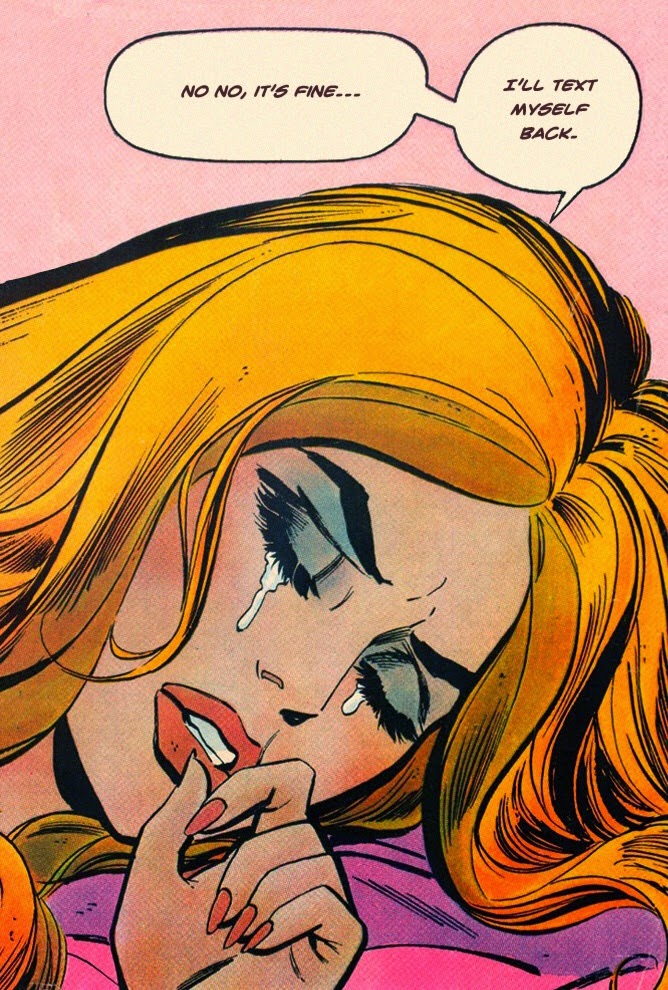
Photo: Tumblr
When a former friend had the idea of creating a blog about food in Harlem I was unsure about whether I could write anything worth reading.  As I continued to write I became more confident and loved the mix of words and images that blogging allowed.  Even before the advent social media, I was the person who always had a camera in hand ready to document the moment.  

Early on in the life of the blog I found myself doing the majority of the writing.  It shifted from being a blog about food to something more personal.  I worked, tutored, job searched, raised Chloe, and maintained a social life, while writing as much as I could and enjoying the thrill of learning something new.  However, I resented the aforementioned former friend passively taking credit for a blog that she rarely contributed to, while complaining that she was "too busy" to write.  Ideas are one thing, execution is another- and I gradually began to make changes to the blog that made it clear whose work it represented.  Maybe I should have communicated before I did this.  Maybe not.  My coattails are purely decorative; they aren't made for riding on.

Brunch @ Ponty Bisto
When the blog was deleted I was shocked by the spitefulness of it; by the nakedness of the insecurity that inspired the action,  but I never thought for a moment that I would not start over.

Thank you to all of the friends, family members, former classmates, students, and exes whose experiences with me have inspired this work. 

Thank you to all of you who take the time to read, comment and share my words. I love your getting emails and texts.

Thank you to those generous friends and family members who have passed along their recipes, beauty secrets, and wisdom. 

Thank you to all of the cousins and second cousins who let me know how upset they were when the first blog "disappeared. 
And most of all thank you to my fabulous friends and family who consent to have their pictures taken even before their first cocktail has arrived!


Saturday, January 24, 2015

Light Girls Was the Silliest Thing I've Seen on Television in a While

A Recent Conversation at an Upper West Side Private School

6th Grader: Ms. Cardwell, are you black?
Me: Yes
6th Grader: So, you're just a very light-skinned black?
Me: Yes
6th Grader: Oh, my nanny was black and she was like my second mother . . .

The patron saint of all light-skinned Negroes

A Conversation at an Independent School in Harlem circa 2009

8th Grader: Ms. Cardwell, you're black?
Me: Yes
8th Grader: Oh, I wasn't sure until you opened your mouth and started yelling . . .

Although my race can be confusing to young children who have yet to be introduced to the One Drop Rule, I think that it is clear to most people that I am a light-skinned black person.  I have broad features, and from what I can remember of it, my natural hair is kinky and coarse.  

I grew up in a family where I was on the browner side of the color spectrum so I never had any doubt that I was black.   I remember a conversation that I had with my late cousin Donna Lynn.  Donna Lynn was like that fashionable big sister that everyone wishes they had.  She wore skintight high-waisted jeans with her straight hair slicked back into a tight ponytail.  Her nails were always long and painted a shade of  cherry red.  One day we were at my grandmother's house in Maryland and I asked her why she didn't pass for white.  She looked at me and said simply "why would I do that?"  Embedded in that question were a thousand statements about self-acceptance, and racial pride.

Donna Lynn as a child
I have always been interested in the issue of colorism in the black community, but when I saw the preview of Light Girls on OWN I cringed/rolled my eyes/sighed deeply and got ready to be embarrassed.  Against my better judgement, I decided to watch so that I would understand what the people on Twitter and Facebook would be talking about the next day.   I was disappointed in Bill Duke's previous film Dark Girls, but this one was even worse!  Listening to light-skinned women complain about being light-skinned is almost as annoying as listening to white people complain about reverse racism.   The experiences depicted in the film have not been my experiences.

For example, I have never:

1.  Been bullied or picked on because of my complexion.   People that I have met may have had preconceived notions about who I am based on the way I look, but I have found that, in general,  if you are nice to people they will be nice to you in return.  Do I have to try a little harder because I'm light-skinned?  Maybe.  Have I developed a self-depreciating sense of humor in order to make others comfortable? Perhaps.  But so what?  All of us adapt our personalities to our environment and our audience.

What was so damaging about Light Girls was the constant reference to darker skinned women as insecure, jealous bullies.  I know that I should accept and validate the experiences and pain of the light-skinned women on the show but . . .  I don't really feel like it.  

2.  Been told or made to feel that I wasn’t black enough.  There was one time in high-school when Brooke Lay said that I was Afrocentric because I was “overcompensating” for my light complexion.  I thought about what she said, considered the fact she claimed that she was bi-racial even though both of her parents were black, and decided not to take offense. 

3. Been treated "better" by a man because I was light-skinned.   I don’t think that I was aware that I  was light-skinned until 9th grade, and by that time I was in high-school and it didn’t matter! There were so few black girls at Columbia Prep that we bonded together in friendship and mutual support. Furthermore, my complexion meant nothing to the black boys I went to school with because they had discovered white girls and wanted absolutely nothing to do with any of us (except the day that Spike Lee's Malcolm X came out in the movie theaters and we all went to see it together). 


As I got older, I acknowledge that my complexion may have been a draw for many of the men that I dated.  However, I learned that if they were attracted to me because I was light-skinned what they really wanted was a white/Asian/ or Latina woman-and usually they went out and got one.  I was like a "gateway drug" and there's no privilege in that.


Really Raven? Are we to assume that this is your natural hair color and you just dyed it for the show too?
The moment I should have turned the TV off and went to sleep was the moment when Raven SymonĂ©  came on and started talking about how she tanned for her show That's So Raven.  It reminded me of my students at The Storefront who used to wistfully talk about how white they were when they were babies.  There's some Pecola Breedlove madness going on when the subtext is "despite what your eyes tell you, I'm not as black as I look."

#truth


In the end, a documentary that had the potential to elevate our thinking about how black people relate to each other ended up being divisive, over-simplistic, and at times silly (where did India Arie come from?)  If you are interested in learning more about colorism read:


The Blacker the Berry, by Wallace Thurman


Monday, January 19, 2015

This Could Be Us But You Playing . . .

Photo:Tumblr

The Year of the Conceited Black Girl!

Jahmeelah Nash-Fuller is one of my favorite students of all time.  Over the years that I have known her she has challenged me, driven me into fits of laughter, and consistently made me proud.  One of my earliest memories of Jahmeelah is of her organizing an America's Next Top Model competition in the park during Summer School. She was only in 5th grade but she exhibited the confidence and style of a much older child.

Circa 2006/07
One of the things that I admired about her was her quick wit and her extremely high-self esteem.  Jahmeelah was so sure of herself that I began to wonder if it was a front for some hidden insecurity.  My cynical self questioned whether any middle-school student could adore themselves that much!

One day I  decided to put her to the test.  I had all of the students in my advisory write a list of 100 things that they liked about themselves.  Most students struggled to get past number ten, yet when I looked over at Jahmeelah she was casually listing characteristic after characteristic.  Not only did she have a lot to say, but she seemed to be enjoying the task!

That convinced me that Jahmeelah was the real thing, so when she named herself "Queen Peaches," that's what I called her (much to the chagrin of her classmates).  When she told me that she thought  that The Bluest Eye presented a negative vision of dark-skinned black people, I listened and added Zora Neale Hurston's essay "How it Feels to be Colored Me" to the curriculum.  When one of her classmates insulted her and she hopped up on a table like a character from Paris is Burning and said "look at these thighs" I laughed until I cried rather than giving her a detention.

Two Queens (Not really sure why she's holding that glass of water like it's wine, though)
During Parent Teacher conferences, I had the chance to ask her mother how she instilled self-esteem in her daughter, especially in a world that does not value aggressively outspoken black girls.  Ms. Nash looked at me and said "every night I pray it into her existence.  I pray it into her spirit."  I admit that at the time, I did not really understand what she was talking about.  I'm not religious so I assumed that her advice was not something that was particularly relevant to me.

That was until one day a few weeks ago.  Chloe and I were at Nicole's house celebrating Morgan's birthday.  We were all sitting on the floor watching television when I heard Mrs. Farrow talking to Morgan.  "Do you know how much I love you?  Do you know how smart you are?  You are so beautiful.  Do you know that?"  It was like a mantra, repeated slowly like a prayer.  One that Morgan had clearly heard before.   One that Chloe will hear every day.

Morgan being fabulous!

So, I am joining ranks with those who have declared that 2015 is "The Year of the Conceited Black Girl."

Photo: Tumblr

There is nothing wrong with being conceited; feeling superior to those who don't acknowledge your light or seek to dim it is ok.   Having an "excessively favorable opinion of one's own abilities or appearance" is not vanity; it's survival.  


Saturday, January 17, 2015

Out of the Mouths of Babes

Her tolerance of nonsense is at an all time low
Back in the day when I spent 10, 000 a year on Preschool,  one of the things that I disliked the most was the birthday parties.  It seemed like every weekend I was buying a gift I couldn't afford and heading to the celebration of one of her friend's birthdays on the Upper West Side.  Even though it can appear otherwise, I am an introvert.  I dislike socializing with people that I don't know (especially when there are juice boxes available instead of wine).  Furthermore, being the only single parent in the mix made me feel awkward and sorry for myself.

Anyway, this weekend when Chloe was invited to a birthday party I was relieved when her father agreed to take her.  The morning of the party I could have sworn that my sweet seven year old had morphed into a sixteen year-old drama queen.  She was stomping around the house slamming doors, messing with her freshly braided hair, and claiming that "nothing was going right today."  I had a feeling that she was afraid that her father wasn't going to show up, even though he had called to reassure her that he was on his way.

When he did arrive we were putting her coat on and she said something about being excited to go her "best friend's" party.  I responded, "that's not your best friend" (the girl had been part of a group that ganged up on Chloe earlier in the year).  She replied, "yes she is, we've known each other since Kindergarten."  I asked if the girl was always nice to her,  and then Chloe went off!!!

She turned to her father and said "well, I only see YOU once every two weeks.  You're just a number in my phone. But you're still my father!  You don't even like my mother! All you do is argue about money. You don't need money to be happy!"  She was preaching like it was Sunday while her father and I stood there with stupid grins on our faces.  She wasn't angry or sad, just very matter-of-fact.

Ridel started hugging Chloe, laughing and telling her that he and I were friends (kinda true), while I slowly made my way up the stairs before she told me more about myself.  I was proud of the way that she expressed herself so directly,  yet sad that the lesson that she is learning is that it is ok for people not to consistently treat her with kindness because of her father's inability or unwillingness to be there when she wants.  One of the things that I like the most about Chloe is that she is an extremely loving child who likes people and makes friends easily.  Everyone in the neighborhood knows her: the mail woman, the crossing guard, the man in the corner store.  She is very much like her father in that way, but unlike him, I want her to know what healthy love looks like as a child.

After the party ended, Chloe and Ridel returned home laughing and tripping up the stairs.  They were excited to share videos of Chloe skating around around like a seasoned pro and Ridel struggling to keep up holding onto the side of the rink.  When we had a moment alone, I asked Ridel what he thought about what Chloe said.  His response was "it was hot!"  Thinking that he has misunderstood the question, I asked again and he repeated, "it was hot; what she said was how she felt, and Chloe never lies.  She said that she needs more time, and I'm going to try to be there for her."  There was no defensiveness, no claims that I was over-reacting.  And because of that there is hope.