
Showing posts with label This is How You Lose Her. Show all posts
Showing posts with label This is How You Lose Her. Show all posts
Wednesday, July 1, 2015
The Half Life of Love is Forever
What a pleasure it is to be able to stay in bed reading all day. In between reading the books that I have to teach next year, I have been revisiting old favorites. I just finished re-reading Junot Díaz's collection of short stories, This is How You Lose Her, and the final story, "The Cheater's Guide to Love" amazed me with it's insight into what Diaz calls "the rise and fall of a Dominican male slut." Curious? Read "The Cheater's Guide to Love" here.


Sunday, April 26, 2015
God Help the Child
I don’t know what I was expecting when I arrived at Barnes
and Noble last Tuesday. Balloons, maybe? A block-long window display of Toni
Morrison: a photograph in profile with her silver dreadlocks flowing and the red lipstick
she wore on the recent cover of The New York Times Magazine. Yes, that is what I expected.
 |
| Illustration by Eva S. |
Instead I saw nothing.
I looked around the bookstore, at times distracted by other novels, wondering if such
an intense search would be necessary when Harper Lee’s new book comes out. Afraid that I had gotten the release date of God Help the Child wrong, I asked someone for help and was directed to a slim stack of
books without one standing up to alert the browser to the presence of the
others. I know that the sale of hardcover books is down and it would have been easier (and cheaper) to download the book on my Kindle, but this is a book I wanted to own. I love that when Chloe sees a picture of Toni Morrison, she says "Look, there's Chloe." These books are part of her inheritance.
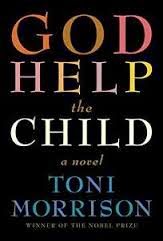
Unfortunately, being the Nobel and Pulitzer prize winning author of eleven novels doesn't guarantee prime real estate in Barnes and Noble. Neither does being the subject of a New York Times Magazine cover or a New York Times Book Review front page review by artist Kara Walker.
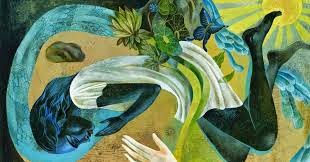 |
| Olaf Hayjek |
Nevertheless, God Help the Child, was the most pleasurable reading experience that I have had in a while. Many people believe that Toni Morrison's books are "too much work" but reading with a pencil in hand is part of the thrill. I read this book when I should have been sleeping, when I was traveling to work on the train, during homeroom- and in 48 hours I was done.
I will not reveal too much of the plot, but I will say that God Help the Child is NOT simply about a light-skinned woman and the mental damage that she causes her dark-skinned daughter, nor is it about racism. As Booker states, "Scientifically, there's no such thing as race . . . so racism without race is a choice. Taught, of course, by those who need it, but still a choice. Folks who practice it would be nothing without it."
As other reviewers have written, God Help the Child, seems to reference many of Toni Morrison's earlier works. Reading it is like meeting old friends who are familiar, yet not exactly as you remember them. Bride reminds me of the dark-skinned woman that Jadine encounters in Tar Baby who threatens her entire perception of beauty. Rain is Amy Denver from Beloved in another form. Brooklyn is as infuriating and one-dimensional as Maureen Peale in The Bluest Eye. And Booker is reminiscent of Son from Tar Baby in that they are both beautiful, eloquent runners.
I will not reveal too much of the plot, but I will say that God Help the Child is NOT simply about a light-skinned woman and the mental damage that she causes her dark-skinned daughter, nor is it about racism. As Booker states, "Scientifically, there's no such thing as race . . . so racism without race is a choice. Taught, of course, by those who need it, but still a choice. Folks who practice it would be nothing without it."
As other reviewers have written, God Help the Child, seems to reference many of Toni Morrison's earlier works. Reading it is like meeting old friends who are familiar, yet not exactly as you remember them. Bride reminds me of the dark-skinned woman that Jadine encounters in Tar Baby who threatens her entire perception of beauty. Rain is Amy Denver from Beloved in another form. Brooklyn is as infuriating and one-dimensional as Maureen Peale in The Bluest Eye. And Booker is reminiscent of Son from Tar Baby in that they are both beautiful, eloquent runners.
Reading books by Toni Morrison books often leaves me with more questions than answers. After reading God Help the Child, I am left wondering if Booker is even black, and why Bride's body begins to revert back to its pre-puberty state after her break-up? What is Morrison saying about black women "having it all" in the modern world? Is the ending ultimately optimistic or pessimistic? Does Toni Morrison write white characters badly on purpose? These type of questions stay with me long after I have finished reading Morrison's books and motivate me to read them again and again. Right now, I am about to pass God Help the Child to my father because he wants to read it. Good thing I bought the hardcover.
If you liked God Help the Child, here are other books you will probably enjoy as well.

Tar Baby and Sula by Toni Morrison
This is How You Lose Her by Junot Diaz
The Blacker the Berry by Wallace Thurman
Saturday, August 23, 2014
How to Stop Haunting the Graveyard

In Toni Morrison's novel, Jazz, Joe Trace says the following to his lover Dorcas: "don't ever think I fell for you, or fell over you. I didn't fall in love, I rose in it." This is one of my favorite Morrison quotes; I find the idea of being transformed and made better by love romantic and inspiring.
Unfortunately, this is not that story. A few years ago I tripped over common sense and fell in love. I fell HARD; I was the old lady at the foot of the stairs whimpering "I've fallen and I can't get up." Things started off on a promising note, but within a few months I was demoted, I quit, and then I begged for my job back. We repeated this cycle over and over for more than two years. The relationship finally ended in the most dramatic, Tyler Perryesque way imaginable (think: motorcycle accident, ER, and somebody getting slapped upside the head in a hospital gown). When the dust settled I was in pain like I had never experienced before. It was so bad that when I woke up in the morning my first thought was getting through the day so that I could return to the oblivion of sleep.
Heartbreak is emotional pain; it is "in your head," but can be so intense that it feels physical. It is an icy sting that begins in the brain, shoots to your stomach, and ends in a dull throb in your chest that keeps you off balance. In my experience, heartbreak was worse than giving birth. When I was in labor I was aware of the purpose of my agony, and I anticipated the gift that I would receive at the end of it. Unfortunately, heartbreak gives no gifts, and although the hurt diminishes in intensity, it never completely ends. Although pain in life in inevitable, many times it can be avoided. Here's how not to be a fool:
1. Trust Your Intuition: My co-workers used to call me The Oracle because of my uncanny ability to predict the outcome of school politics months ahead of time. I hate to admit it, but I have no supernatural powers. I believe that we all have the ability to read body language and hear what is being said underneath the surface of words. Unfortunately, in matters of the heart we often ignore what we know to be true because of what we want to be true. Stop lying to yourself.
2. Stop Thinking That You Are An Exception: Listening is key. If a person describes all of the people in his/her past as "crazy" what do you think that he will be saying about you in the end? Don't be flattered by compliments that come at the expense of others.
3. Protect Your Magic: Avoid people who think that it is their place to tell you about yourself. Oftentimes what people say about you is a reflection of how they are feeling about themselves at the moment. Leave anyone who is not kind to you alone. Period.
4. Accept That Behavior is Communication: I remember hearing this phrase at a professional development workshop about working with children with discipline issues and it was a revelation in terms my personal life. Often we complain about dating others with "bad communication skills." We justify being disappointed (again) by blaming "a breakdown in communication." We wish that he/she would "communicate more." This is bullshit; although the man or woman in question may not be the type to engage in deep discussions about how they are feeling; their behavior will tell you everything that you need to know. If they don't text you back in a reasonable amount of time, or make an effort to see you consistently, they are communicating that you are not a priority. As my friend Jackie says, "there are no such things as 'mixed signals,'" when someone wants you in their life they make it happen. If you have to decode and analyze conversations, text messages, and emails with your friends looking for affirmation you are wasting your time. An inconsistent person may not want to be alone. That does not mean that he/she wants to be in a relationship with you. Learn the difference and act accordingly.

5. Don't Let Anyone Walk off With All of Your Stuff: In For Colored Girls, the lady in green says, "somebody almost walked off wid alla my stuff and didn't care enough to send a note home saying I was late for my solo conversation." People were walking away with my stuff because I was giving it away! In the midst of my heartbreak I was lucky to have friends who were around to make me laugh and give me meaningful advice. One such person was Colin, who told me that I needed to "stop giving." Although these directions were genius in their simplicity, I also needed to think about when my generosity was a dressed up form of manipulation. If I was giving because I expected something is return, and then turning around feeling used when I didn't get it, I had no one to blame but myself. I came to this conclusion after watching an episode of The Real Housewives of New Jersey. I guess that Chloe was right: you can learn important stuff by watching television.

6. Recognize When It's Over: In his collection of short stories, This is How You Lose Her, Junot Diaz writes "And that's when I know it's over. As soon as you starting thinking about the beginning, it's the end." When you are remaining in contact with someone in the hopes of reclaiming a past feeling you are dealing with an addiction, not a relationship. Zora Neale Hurston says,
I have a strong suspicion, but I can't be sure, that much that passes for constant love is a gilded-up moment walking in it's sleep. Some people know that it is the walk of the dead, but in desperation and desolation, they have staked everything on life after death and the resurrection, so they haunt the graveyard. They build an altar on the tomb and wait there like faithful Mary for the stone to roll away. So the moment has authority over their lives.
Unless your initials are J.C. you don't have to power to resurrect what is dead. In fact, by the time that Joe Trace made his noble pronouncements about love he had already shot his lover because he couldn't accept that the relationship was over. I remember Jackie and I having a conversation about delaying ending relationships because of the fear of the pain that we knew was coming. Unfortunately, there's no shortcut through pain. The more you delay it; the more it will hurt.

7. Forgive Yourself: I remember telling Colin about the latest episode in the drama of my relationship with whatshisname. He cut me off and said "I'm really sorry that happened to you. What he did was fucked up. But what you did to yourself was worse." Damnnnnn!! The truth hurts. Recognize that your role in the drama, analyze why you allowed what you allowed, make an attempt to heal the wound, and forgive yourself.

Book Club for the Broken Hearted:

For Colored Girls Who Have Considered Suicide When the Rainbow is Enuf, by Ntozake Shange
This is How You Lose Her, by Junot Diaz
Dust Tracks on a Road, by Zora Neale Hurston
Subscribe to:
Posts (Atom)